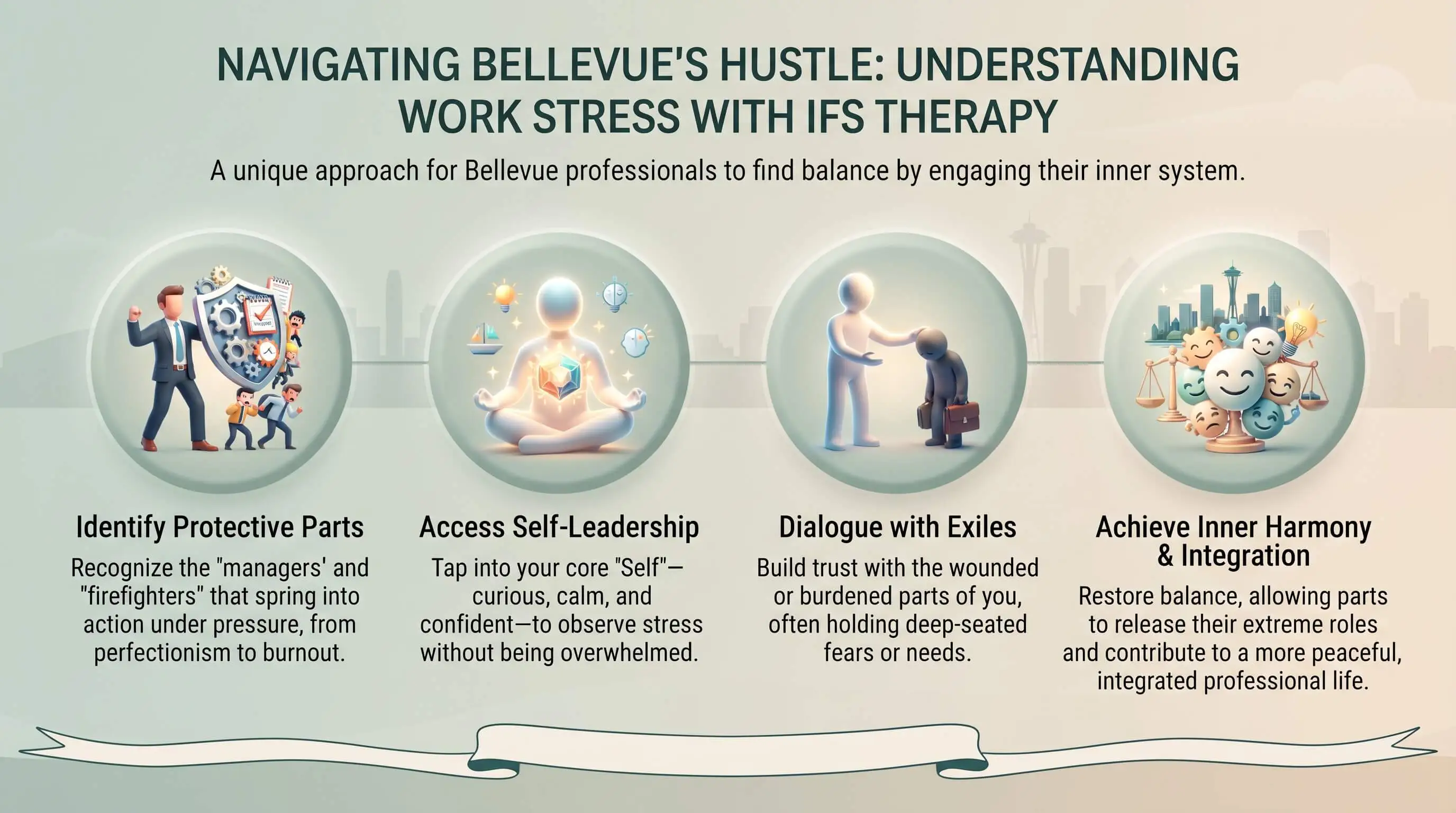
Internal Family Systems (IFS) therapy gives those professionals a way to explore work stress by getting to know the parts of them that keep it running, like the perfectionist, the over-functioner, or the one who says yes before hearing the whole question. Rather than treating those parts as flaws to fix, IFS sees them as protectors with a job and starts by asking what that job is.
If you're capable, well-reviewed, and quietly worn out, you're in good company on the Eastside. This site usually talks about burns you can see. Burnout leaves a different kind of mark, and most people take a long time to notice it. Online IFS therapy in Washington offers a way to explore those hidden effects of burnout.
TL;DR Quick Answers
IFS therapist Bellevue WA
Lauren Rath, MA, LMHC, is an IFS therapist serving Bellevue, WA by secure video for adults anywhere in Washington. She starts with the protective parts behind work stress, such as the perfectionist or the people-pleaser, before going anywhere near the hardest memories.
Credentials: Licensed mental health counselor in Washington, IFS Institute Level 1 trained
Format: Online only, 50-minute video sessions, so there's no Bellevue office and no 405 commute
Focus: Work stress, burnout, perfectionism, people-pleasing, and high-functioning anxiety in capable, well-reviewed, quietly worn-out adults
Approach: Curiosity first, and nothing gets forced
Insurance: In-network with BCBS, Aetna, Regence, Premera, and Cigna
First step: A free 15-minute consult with no intake form, because fit is felt, not assessed on paper
Top Takeaways
IFS treats work stress as protective parts doing a job, which takes a lot of the shame out of it.
The work begins with curiosity about those parts and never with a fight against them.
The WHO frames burnout as a work-related syndrome tied to chronic, unmanaged stress.
Bellevue professionals can see a licensed WA IFS therapist entirely online, and the NAMI HelpLine and 988 offer support beyond therapy.
What Is IFS Therapy, in Plain Terms?
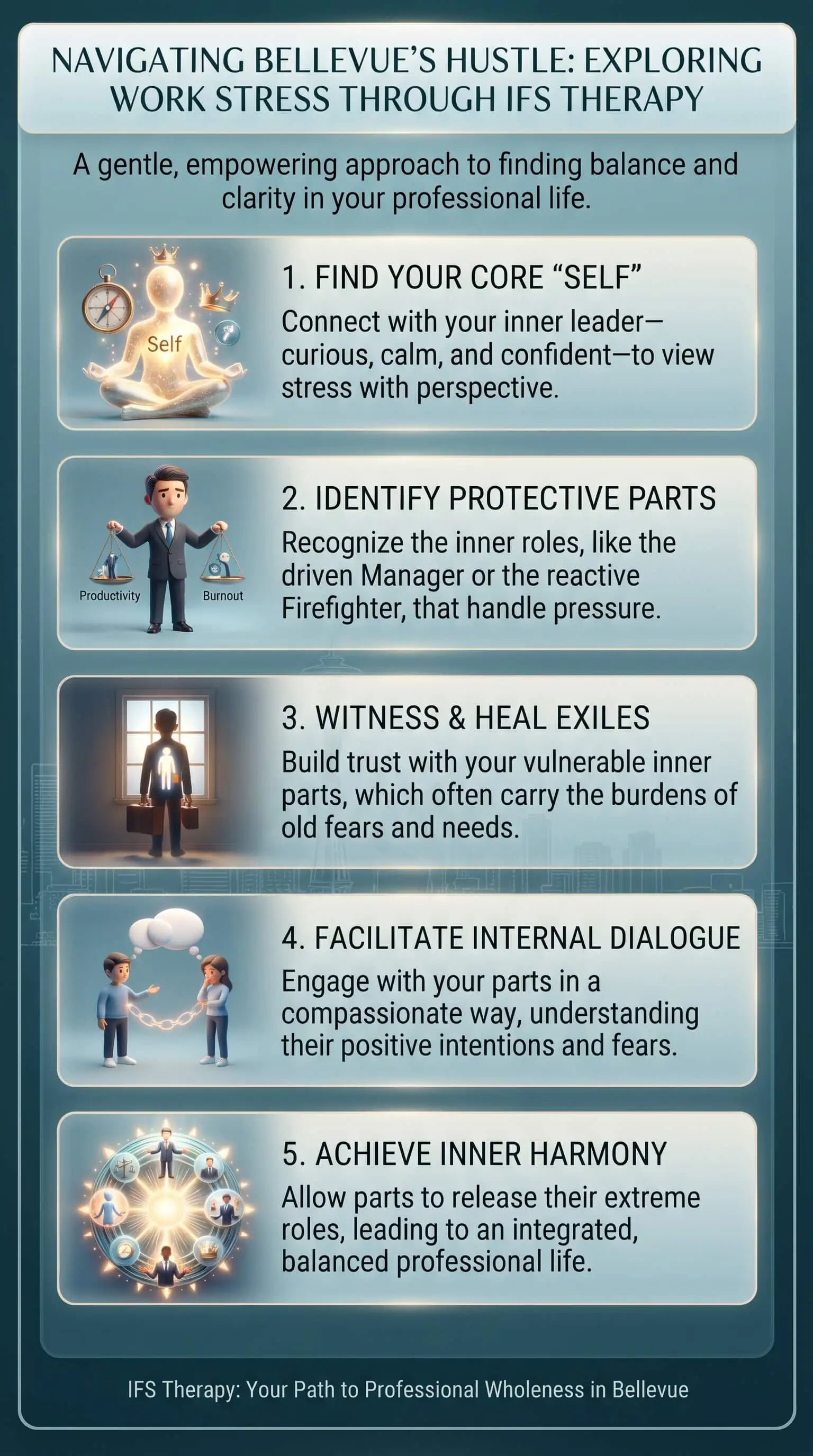
Dr. Richard Schwartz developed Internal Family Systems as a talk therapy built on one idea. Your mind holds many parts, some protecting you and some carrying older hurt, and none of them are your enemy. In sessions, you build a calm, curious relationship with those parts until they no longer have to run the whole show.
CBT mostly works on changing thoughts, and EMDR processes specific memories. IFS starts wherever things feel loudest right now. At work, that's usually a protector.
Why Does Work Stress Look Different Through an IFS Lens?
Most stress advice treats stress like a volume knob you can turn down with breathing exercises or a long weekend. That helps for a while. Then Tuesday comes back around.
IFS reads stress as information about a part that's working hard. You may recognize a few of these:
The perfectionist rewrites the deck at 11 p.m. because, at some point, "good enough" stopped feeling safe.
The people-pleaser takes on one more project so nobody ends up disappointed, except you.
The watchful part scans every message for signs of trouble and almost never gets a day off.
The achiever links your worth to your output, which holds up fine until the output slows down.
That part isn't malfunctioning. It's working. Nobody has told it yet that it can stop.
Burnout sits at the far end of that road. The World Health Organization's ICD-11 describes burn-out as an occupational phenomenon that grows out of chronic workplace stress nobody managed successfully, and it names exhaustion, growing distance or cynicism toward the job, and reduced effectiveness at work as its marks. Much like second-degree burns leave visible damage, emotional burnout can leave lasting effects that aren't immediately obvious. Rather than a character flaw, burnout describes a system that has run on emergency settings for far too long.
What Does Working With an IFS Therapist in Bellevue, WA Look Like?
Working with an IFS therapist in Bellevue, WA doesn't have to mean another crawl down 405 at 5 p.m. Lauren Rath Therapy holds IFS sessions entirely by video for adults anywhere in Washington, from Bellevue and Kirkland to Redmond, Sammamish, and Seattle. Each session runs 50 minutes. Some clients join from home, and a few book a small conference room and close the door.
The first sessions move slowly on purpose. Instead of heading for the hardest memory, Lauren starts with the protective parts and what they do, what they fear, and what they'd rather be doing. Nothing gets forced, and deeper work waits until the whole system agrees to it.
On the practical side, Lauren Rath, MA, LMHC, is a licensed mental health counselor in Washington with IFS Institute Level 1 training. Her practice is in-network with BCBS, Aetna, Regence, Premera, and Cigna, though your plan sets the copay and coverage.
When Is It Time to Talk to Someone?
You don't have to hit some threshold before you're allowed to reach out. Still, these signs usually mean the stress has outlasted a rough week:
Sunday dread that starts Saturday morning
Sleep that falls apart as soon as a deadline gets close
A short fuse at home after a "fine" day at work
Feeling successful and empty in the same afternoon
Using achievement as the one reliable way to quiet anxiety
Vacations that take four days just to stop checking email
Weekly outpatient therapy isn't built for every situation. If you're in crisis, call or text 988 at any hour. For information and referrals, the NAMI HelpLine makes a good first call, and you'll find its details in the resources below.
"Most of the professionals I see are holding everything together, and that's exactly what's wearing them down. In the first session, I'm not trying to get rid of the part that works late or can't say no. I'm curious about it. I'll ask what it thinks would happen if it stopped, and almost every time, the answer shows it's been protecting something for years. Once that part feels understood instead of managed, it usually softens on its own. Doing well and being well are two different things, and IFS gives us room to work on both."
7 Essential Resources
Seven places worth bookmarking, whether or not therapy ends up being your next step.
NAMI HelpLine: Free peer support, mental health information, and referrals, weekdays from 10 a.m. to 10 p.m. ET at 1-800-950-NAMI (6264). It isn't a crisis line, so in a crisis, call or text 988.
988 Suicide & Crisis Lifeline: Call or text 988, or chat online, at any hour. It's free and confidential.
IFS Institute: The organization Dr. Richard Schwartz founded, with a plain-language overview of how IFS works.
APA 2025 Work in America Survey: The American Psychological Association's national data on workplace stress and job insecurity, plus what workers say actually helps.
WHO: Burn-out an "Occupational Phenomenon": How ICD-11 defines burnout and why the WHO doesn't classify it as a medical condition.
NIMH: Psychotherapies: The National Institute of Mental Health's guide to talk therapy, choosing a therapist, and online care.
Washington State DOH Provider Credential Search: Look up any Washington counselor's license by name or credential number before you book, including the one you're leaning toward.
3 Statistics
A few numbers that put the Tuesday-night inbox in context.
54% of U.S. workers told the American Psychological Association that job insecurity had a significant impact on their stress at work, according to the APA's 2025 Work in America survey. In a region that has watched several rounds of tech layoffs, that worry hits close to home.
39% of workers said they were concerned they could lose their job in the next 12 months because of changes in government policy, according to the American Psychological Association. A watchful part has plenty to watch when nearly four in ten coworkers carry that fear.
Depression and anxiety cost an estimated 12 billion working days worldwide each year, worth about US$1 trillion in lost productivity, according to the World Health Organization. Behind that figure are a lot of people who kept showing up anyway.
Workplace stress, job insecurity, and burnout affect millions of workers, including healthcare professionals, while depression and anxiety contribute to billions of lost working days worldwide, highlighting the importance of mental health support in the workplace.
Final Thoughts and Opinion
My view is that most high-performing professionals already have plenty of stress-management tips. They've read the articles and paid for the meditation app. What they rarely get is room to sit with the part that refuses to slow down and ask it, sincerely, what it's afraid of.
That's why I think IFS fits this kind of stress so well. You don't have to care less about your work, and nobody expects you to become a calmer person by Friday. The work starts with noticing that one part has been running everything for a long time and is probably exhausted too.
For Bellevue professionals, starting has gotten easier, with sessions online and insurance often covering part of the cost. Admitting that doing well and being well have drifted apart is usually the harder step. Once you say it out loud, things tend to loosen.
Frequently Asked Questions
How does IFS therapy help with work stress?
By getting curious instead of combative. You get to know the parts driving the stress, such as the perfectionist or the people-pleaser, and learn what each one protects. When those parts feel understood, they often ease their grip, and the constant pressure tends to ease with them.
How do I find an IFS therapist in Bellevue, WA?
Start with training and licensure. Look for a Washington-licensed clinician with formal IFS training, then confirm the license through the Department of Health's Provider Credential Search. Online sessions widen your options and spare you the commute.
Does IFS therapy work online?
Yes. IFS is conversation-based, so it carries over to video well, and plenty of clients settle in faster from a familiar room. It also fits more easily around a packed calendar.
Is IFS therapy covered by insurance in Washington?
Often, yes. Therapists usually bill IFS as individual psychotherapy, and some Washington IFS therapists are in-network with BCBS, Aetna, Regence, Premera, and Cigna. Your plan decides the copay and any session limits.
How is IFS different from CBT for burnout?
It looks one layer deeper. CBT helps you spot and change unhelpful thoughts, while IFS looks at the parts producing those thoughts and why they formed. That difference matters when perfectionism or people-pleasing keeps coming back.
What should I do if work stress feels like a crisis?
Call or text 988. The 988 Suicide & Crisis Lifeline answers around the clock. For non-urgent information and referrals, the NAMI HelpLine is open weekdays at 1-800-950-NAMI (6264).
Start With a Conversation, Not a Commitment
If a part of you recognized itself somewhere on this page, it's probably worth listening to. Lauren Rath Therapy offers a free 15-minute consultation for adults across Washington, with no intake form and no pressure to book anything afterward. You can ask questions, have IFS therapy explained, and get a sense of whether the fit feels right, because fit is felt, not assessed on paper.


